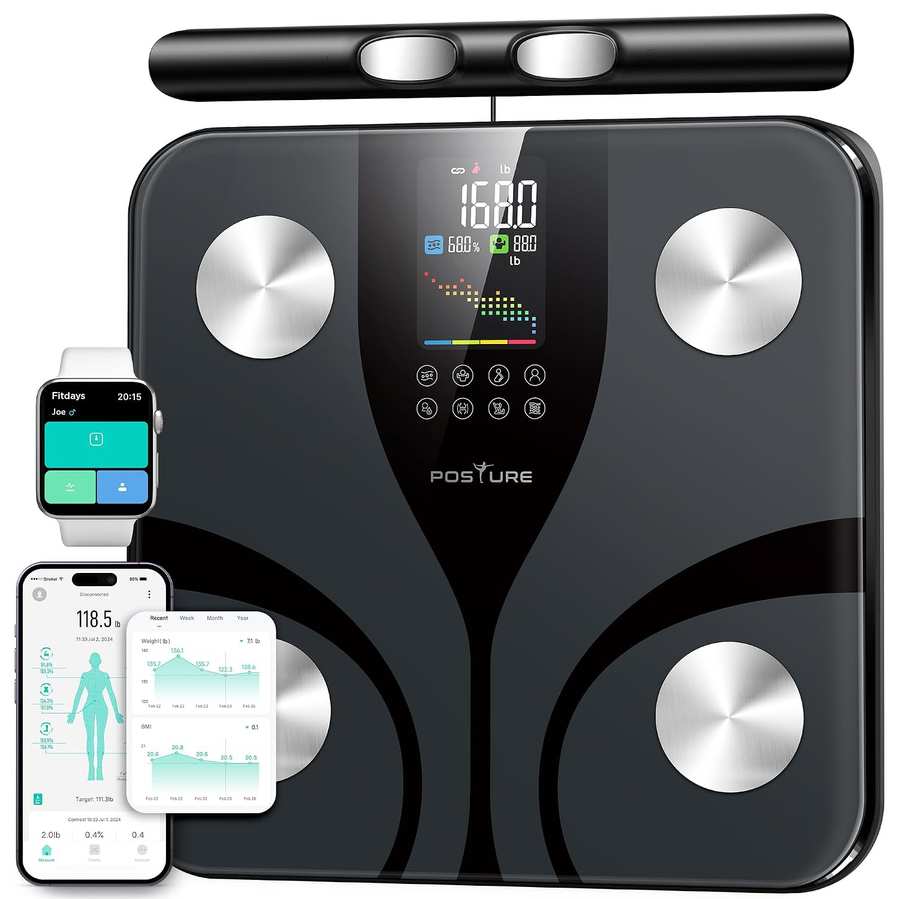
CES 2026 was full of them. Smart scales with eight electrodes, twelve electrodes, even scales that claimed to measure segmental body composition through your feet alone. "Know your muscle quality in each leg!" one booth shouted. "Track visceral fat trends from your bathroom!" another promised. I spent two days testing these devices, reading their white papers, and talking to their engineers. And I left Las Vegas with a clear verdict: most consumer segmental analysis is marketing hype dressed in scientific language. The technology is real. The application in a fifty-dollar bathroom scale is not.
Segmental body composition analysis means measuring the body composition of individual segments — left arm, right arm, left leg, right leg, trunk — rather than just estimating a whole-body average. In professional devices like the InBody 970, this is done using multiple electrodes placed on both hands and both feet, allowing the device to measure electrical current flow through each limb and the torso independently. It is a genuine engineering achievement, and when done correctly, it provides useful information about regional muscle imbalances and fat distribution.
But here is what the CES marketing materials do not tell you: accurate segmental analysis requires precise electrode placement, controlled testing conditions, and validated equations specific to each body segment. A consumer scale that asks you to stand barefoot on four metal pads cannot accurately measure your arm composition because the current never passes through your arms. It cannot measure your trunk composition independently because the current path through the torso is confounded by the legs. The "segmental" data on these consumer devices is not measured. It is estimated. And the estimation is based on assumptions that break down for anyone who does not match the average population.
📊
Bioelectrical Impedance Guide
Understand how BIA works, what affects accuracy, and how to get the most consistent readings. Hydration, electrode placement, consumer vs professional devices.
All data stays in your browser — we never see it.
I tested three of the most popular segmental smart scales at CES against each other and against the professional InBody 970. The results were sobering. For whole-body body fat percentage, the consumer scales deviated from the InBody by 4% to 7% on average. For segmental data, the deviation was even larger — 8% to 15% for individual limb estimates. One scale told me my left leg had 22% body fat while my right leg had 18%. My DEXA scan from the previous month showed both legs at 19.5% with less than 0.3% difference between them. The scale was not measuring my legs. It was guessing.
The "muscle quality" metric was even worse. One scale reported a "muscle quality index" of 78 for my right arm and 82 for my left. When I asked the engineer what these numbers meant, he said they were proprietary algorithms based on phase angle and impedance ratios. When I asked for validation data, he said it was "in development." When I asked whether the index correlated with actual muscle strength or biopsy data, he changed the subject. These numbers are generated by algorithms that have never been validated against physiological reality. They are fiction with decimal points.
📊
Body Fat Percentage Estimator
Estimate your body fat percentage using the Navy method, YMCA method, or 3-site/7-site skinfold Jackson-Pollock equations. Free. Private. No data leaves your browser.
All data stays in your browser — we never see it.
Here is the comparison between consumer segmental scales and professional segmental BIA:
| Feature | Consumer Segmental Scale | Professional Segmental BIA | DEXA |
|---|
| Electrodes | 4 (feet only) | 8 (hands + feet) | N/A |
| Segmental measurement | Estimated, not measured | Measured via current paths | Direct X-ray attenuation |
| Whole-body BF error | ±4-7% | ±2-4% | ±1-2% |
| Segmental BF error | ±8-15% | ±3-5% | ±1-2% |
| Muscle quality metric | Proprietary, unvalidated | Phase angle (validated) | Regional lean mass |
| Visceral fat estimate | Algorithm-based guess | Algorithm-based estimate | Direct measurement |
| Price | $50-$200 | $2,000-$6,000 | $50-$150 per scan |
📊
Lean Body Mass Calculator
Calculate lean body mass from weight and body fat percentage. Includes bone mass estimate, organ mass reference ranges, and residual mass breakdown.
All data stays in your browser — we never see it.
The visceral fat claim is particularly egregious. True visceral fat measurement requires imaging — CT, MRI, or DEXA — that can distinguish fat inside the abdominal cavity from subcutaneous fat under the skin. BIA cannot see inside your abdomen. It measures electrical resistance through your body and applies an equation that estimates visceral fat from total body fat, waist circumference, and age. The consumer scale does not even measure your waist. It estimates your waist from your height and weight. Then it estimates your visceral fat from the estimated waist. That is an estimate of an estimate. It is not data.
I am not saying all smart scale features are useless. Weight tracking is useful. Trend tracking under consistent conditions is useful. Some scales do a reasonable job of estimating total body water for hydration monitoring. But segmental body composition analysis from a bathroom scale is not science. It is speculation wrapped in a user interface.
The engineers I spoke to at CES were not malicious. They were doing their jobs — building products that sell. The problem is the gap between what the technology can do and what the marketing claims it does. A four-electrode foot scale cannot measure your arm muscle quality. It cannot measure your visceral fat. It cannot provide segmental data that is accurate enough to guide training or nutrition decisions. Pretending otherwise is not innovation. It is deception.
Can a smart scale accurately measure body composition by segment?
No. Consumer scales with foot-only electrodes cannot measure arm or trunk composition directly. The segmental data is estimated from whole-body measurements using unvalidated assumptions. Error margins for segmental estimates are 8% to 15%.
What is phase angle and does it matter?
Phase angle is a BIA-derived metric that correlates with cell membrane integrity and muscle quality. It is validated in research settings with professional multi-frequency devices. Consumer scales report phase angle estimates that have not been independently validated and should not be used for clinical decisions.
Why do different smart scales give different segmental readings?
Because each brand uses different proprietary algorithms to estimate segmental data from limited whole-body measurements. There is no standardization. The variation between brands often exceeds actual body composition change over months.
Is there any value in consumer scale segmental data?
Minimal. The whole-body trend may be directionally useful under consistent conditions. The segmental breakdowns are not reliable enough for training or nutrition decisions. For accurate segmental analysis, use DEXA or professional eight-electrode BIA.
Will smart scale segmental analysis ever become accurate?
Not without fundamental hardware changes. Accurate segmental analysis requires hand electrodes to measure current through the upper body and trunk. Foot-only scales cannot overcome this physical limitation regardless of software improvements.
I bought a fifty-dollar smart scale at CES because I needed a prop for a workshop. I use it to weigh myself. I ignore the body fat percentage. I laugh at the segmental breakdown. And I remind myself every morning that good data is expensive because it is hard to produce. Your bathroom scale is not a DEXA machine. It is a scale. Use it for weight. Leave the composition to the tools that earn your trust.
Your legs deserve better than a guess.
— Emily Clarke, Exercise Physiologist & Former Fitness Studio Body-Testing Lead