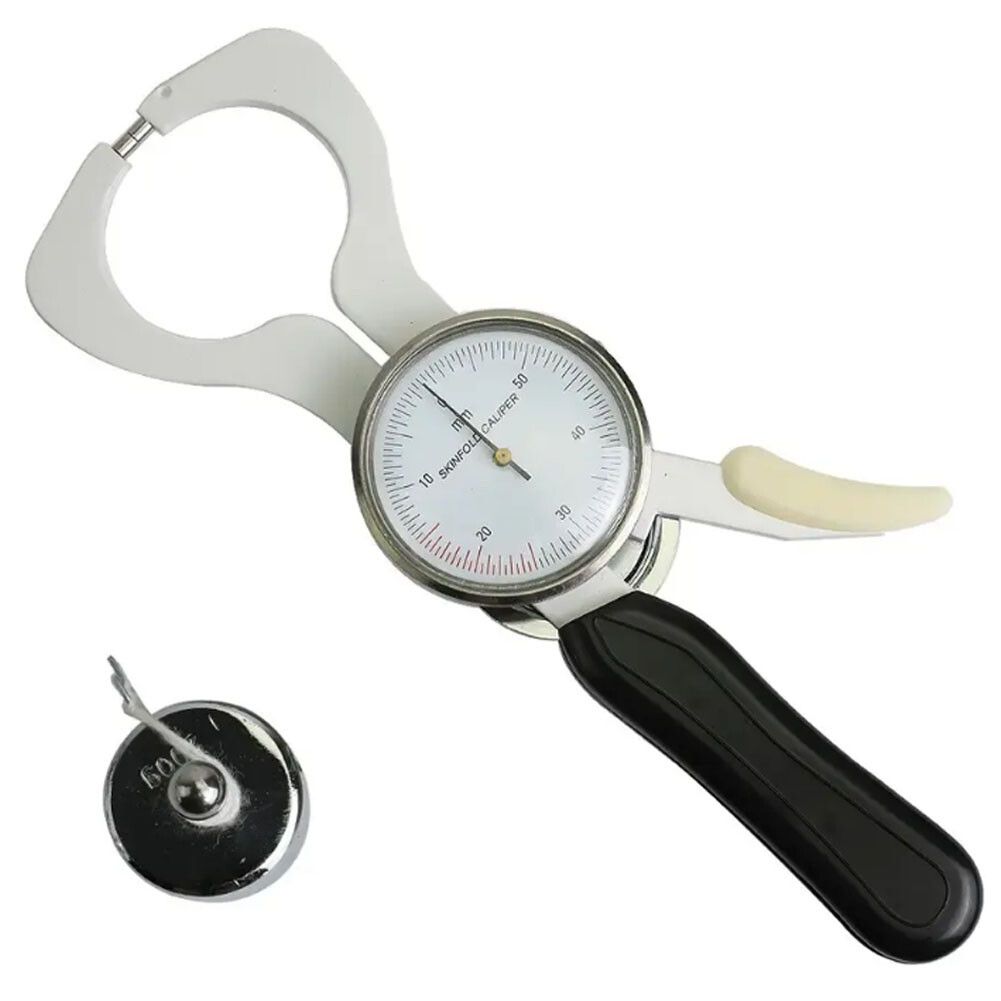
I own nine pairs of skinfold calipers. Nine. I have tested them all against DEXA, against each other, and against the same client on the same day. Some cost twelve dollars. Some cost three hundred. Some are precision instruments. Some are toys. And after four years of daily use in a professional testing environment, I can tell you exactly which ones are worth your money and which ones belong in a drawer.
Skinfold calipers are the most underappreciated body composition tool available. They cost a fraction of a DEXA scan, require no electricity, work anywhere, and when used correctly with a standardized protocol like the 7-site Jackson-Pollock method, they can achieve accuracy within plus or minus 3% to 4% of DEXA. That is better than most consumer BIA scales. Better than most gym body fat machines. And infinitely better than a smartphone app that guesses from your photo. The catch is that the caliper matters. The technician matters more. But the caliper still matters.
📊
Skinfold Measurement Tracker
Log your skinfold measurements over time. Site selection guide, mm trend chart, and technician error warnings. All data stored locally.
All data stays in your browser — we never see it.
Let me start with the cheap ones, because that is where most people begin. The Accu-Measure Fitness 3000 is the twelve-dollar plastic caliper you see in every sporting goods store. It is spring-loaded, has a simple pressure gauge, and is designed for self-measurement of a single site. Is it accurate? No. The spring tension is inconsistent, the jaw pressure varies with hand strength, and the single-site measurement cannot produce a reliable body fat percentage. But is it useful? Surprisingly, yes. For someone who wants to track whether their single abdominal skinfold is trending up or down over time, the Accu-Measure is a perfectly adequate trend tracker. Just do not trust the body fat percentage it prints. It is fiction.
The Lange caliper is the gold standard of professional skinfold testing. It is made of metal, has a calibrated spring that exerts exactly ten grams per square millimeter of jaw pressure, and is accurate to within plus or minus 0.2 millimeters. It costs around two hundred to two hundred fifty dollars, and it is the caliper I used for every professional test at our Portland studio. The Lange is not just accurate. It is consistent. Two different technicians using two different Lange calipers on the same client will get readings within 0.5 millimeters of each other. That level of inter-rater reliability is what makes professional skinfold testing viable.
📊
Body Fat Percentage Estimator
Estimate your body fat percentage using the Navy method, YMCA method, or 3-site/7-site skinfold Jackson-Pollock equations. Free. Private. No data leaves your browser.
All data stays in your browser — we never see it.
Here is my hands-on comparison:
| Caliper | Price | Material | Accuracy vs DEXA | Best For |
|---|
| Accu-Measure Fitness 3000 | $12 | Plastic | ±6-10% | Single-site trend tracking |
| Sequoia Fitness TrimCal 4000 | $18 | Plastic | ±5-8% | Budget self-measurement |
| Harpenden | $280 | Metal | ±2.5-3.5% | Research-grade precision |
| Lange | $220 | Metal | ±2.5-3.5% | Professional testing |
| Skyndex | $350 | Metal + digital | ±2.5-3.5% | Clinics with digital records |
| Slimguide | $45 | Plastic | ±4-6% | Home use with basic training |
The Harpenden is the Lange's British cousin — slightly heavier, slightly more expensive, and built like a surgical instrument. Some researchers prefer the Harpenden for its slightly wider jaw span, which can be easier to position on larger clients. I find the Lange and Harpenden functionally identical in accuracy. Choose based on availability and price. Both are excellent.
📊
Bioelectrical Impedance Guide
Understand how BIA works, what affects accuracy, and how to get the most consistent readings. Hydration, electrode placement, consumer vs professional devices.
All data stays in your browser — we never see it.
The Skyndex is the digital option for clinics that want to eliminate manual calculation errors. It stores population-specific equations — Jackson-Pollock, Durnin-Womersley, Yuhasz — and automatically calculates body fat percentage after you enter the skinfold measurements. The digital display reduces transcription errors, and the built-in equations are well-validated. The downside is the price — three hundred fifty dollars — and the fact that the digital component adds a point of failure. If the battery dies or the software glitches, you have a very expensive paperweight. I prefer the Lange with a manual calculation. It never runs out of batteries.
The Slimguide is the best budget option for home users who want to learn proper technique. At forty-five dollars, it is plastic but well-built, with a consistent spring and clear markings. It is not professional-grade, but it is good enough for home tracking if you practice your technique. I recommend the Slimguide to clients who want to measure themselves monthly between professional tests. With practice and a standardized protocol, it can produce readings within plus or minus 4% to 6% of DEXA — not clinical accuracy, but useful for trend tracking.
The most important factor in skinfold accuracy is not the caliper. It is the technician. A Lange in the hands of an untrained person produces worse data than a Slimguide in the hands of someone who has practiced. The key skills are site identification, jaw placement, pressure consistency, and reading the scale perpendicular to the markings. I trained our studio technicians for forty hours before allowing them to test clients unsupervised, and even then we cross-checked their readings against mine for the first month. Skinfold testing is a skill, not a gadget. The caliper is just the tool.
What is the best skinfold caliper for home use?
The Slimguide at around $45 is the best balance of quality and affordability for home users. For professional testing, the Lange or Harpenden at $220-$280 is the gold standard. Avoid single-site plastic calipers for body fat percentage estimation.
How accurate are cheap plastic calipers?
Cheap plastic calipers have error margins of plus or minus 6% to 10% compared to DEXA due to inconsistent spring tension and poor jaw pressure calibration. They are adequate for single-site trend tracking but not for accurate body fat percentage measurement.
Can I measure my own skinfolds accurately?
With practice, yes, but self-measurement is inherently less accurate than measurement by a trained technician because you cannot see or access some sites properly. For home use, focus on accessible sites like the abdominal and thigh, and use our Skinfold Measurement Tracker to log trends over time.
How often should skinfold calipers be calibrated?
Professional metal calipers should be calibrated annually using a calibration block. Plastic calipers cannot be calibrated and should be replaced every one to two years as the spring tension degrades. If your caliper readings start drifting, it is time for a new one.
Is the 7-site Jackson-Pollock method the best skinfold protocol?
For general body composition, yes. The 7-site method samples subcutaneous fat from multiple body regions and produces the most reliable body fat percentage estimate. The 3-site method is faster and nearly as accurate for most people. Single-site methods are not recommended for total body fat estimation.
I keep all nine calipers in a drawer in my home office. The Lange sits on top. The Accu-Measure is at the bottom, reserved for demonstrations of what not to buy. Every time a client asks me what caliper to get, I hand them the Lange and say: "This one. It costs more than the plastic ones because it is worth more. Your body composition data is worth the investment."
Measure well. Measure consistently. Measure with tools that earn your trust.
— Emily Clarke