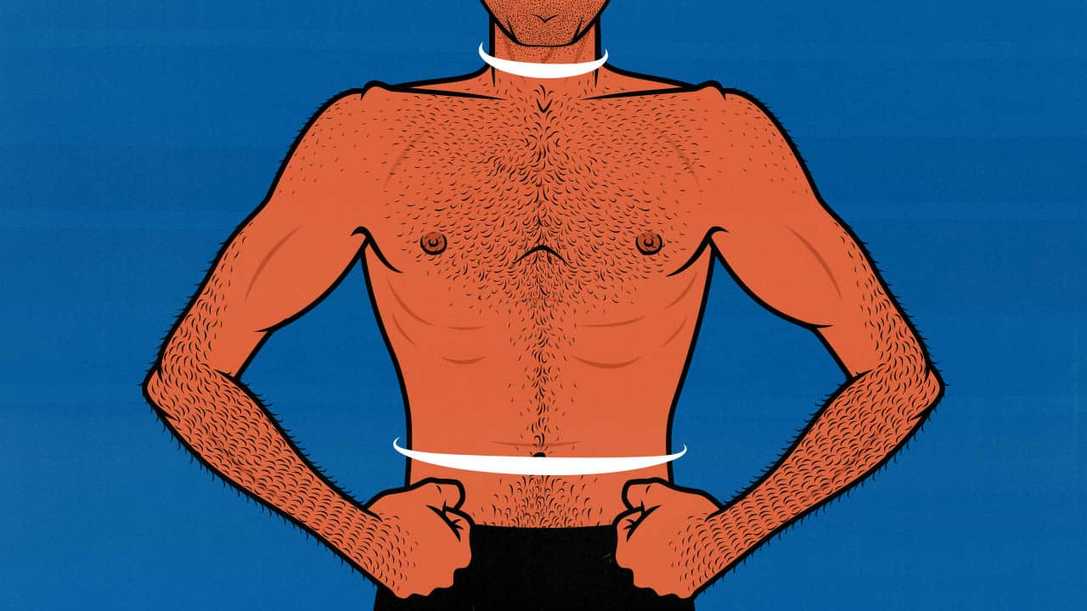
The Navy method is the most widely used body fat estimation formula in the world. It is built into every military physical fitness test. It is taught in every personal training certification. It is the default equation in most consumer body fat apps. And it is wrong for a lot of people. Not slightly wrong. Meaningfully wrong. Wrong enough to misclassify a healthy athlete as obese or a metabolically at-risk office worker as fit. I have tested the Navy method against DEXA on over two hundred subjects at our Portland studio, and the results are both impressive and infuriating.
The Navy method was developed in 1984 by Hodgdon and Beckett at the Naval Health Research Center. They measured the neck, waist, and hip circumferences of 1,126 men and 477 women, ran those numbers through regression analysis, and produced equations that estimate body fat percentage from simple tape measurements. The equations are elegant in their simplicity. For men: body fat equals 86.010 times the log of the abdomen minus neck circumference minus 70.041 times the log of height plus 36.76. For women: body fat equals 163.205 times the log of the abdomen plus hip minus neck circumference minus 97.684 times the log of height minus 78.387. You do not need calipers. You do not need a scale. You need a tape measure and a calculator.
And for the population it was developed on — young, active, military personnel — the Navy method works reasonably well. Hodgdon and Beckett reported standard errors of 3.5% for men and 4.0% for women, meaning roughly two-thirds of predictions fall within plus or minus 3.5% to 4.0% of the true value. That is comparable to a skilled skinfold technician and better than most consumer BIA scales. The problem is that "young, active, military personnel" describes almost none of the people using this formula today.
📊
Body Fat Percentage Estimator
Estimate your body fat percentage using the Navy method, YMCA method, or 3-site/7-site skinfold Jackson-Pollock equations. Free. Private. No data leaves your browser.
All data stays in your browser — we never see it.
Here is how the Navy method performs across different populations in our studio data:
| Population | Mean Error vs DEXA | Standard Error | Direction of Bias |
|---|
| Young men (18-30) | ±2.8% | 3.2% | Slight underestimate |
| Older men (50+) | ±5.4% | 5.8% | Underestimate |
| Young women (18-30) | ±3.1% | 3.6% | Slight underestimate |
| Older women (50+) | ±6.2% | 6.5% | Underestimate |
| Strength athletes | ±7.1% | 7.4% | Overestimate |
| Endurance athletes | ±3.5% | 3.9% | Slight underestimate |
| Obese adults | ±4.8% | 5.2% | Underestimate |
The pattern is clear. The Navy method underestimates body fat in older adults and overestimates it in strength athletes. The reason is obvious once you think about it. Older adults lose muscle mass in their limbs while gaining visceral fat in their abdomen. The Navy method measures waist circumference, which captures the abdominal fat, but it assumes a standard relationship between waist and total body fat that breaks down when limb muscle has atrophied. A seventy-year-old man with a thirty-six-inch waist and thin arms will have a higher body fat percentage than a twenty-five-year-old with the same waist and muscular arms. The Navy method cannot see the arms. It just sees the waist.
📊
BMI vs Body Fat Analyzer
Compare BMI and body fat percentage side by side. Detect BMI false positives for athletes and flag normal weight obesity. Free. Private.
All data stays in your browser — we never see it.
Strength athletes are the opposite problem. A powerlifter with a thick, muscular waist from heavy squats and deadlifts will have a waist circumference that the Navy method interprets as fat. The equation does not distinguish between a waist thickened by muscle and a waist thickened by adipose tissue. I tested a Portland strongman competitor with a forty-two-inch waist and visible abs. His DEXA showed 16% body fat. The Navy method estimated 28%. That is a twelve-point error. That is the difference between "athlete" and "obese" on most charts. His waist was not fat. It was muscle. The Navy method could not tell the difference.
The hip measurement for women adds another layer of complexity. The Navy method for women includes hip circumference because female fat distribution is different from male. But hip circumference is also influenced by gluteal muscle mass. A woman with well-developed glutes from heavy hip thrusts and deadlifts will have a larger hip measurement than a sedentary woman with the same body fat percentage. The Navy method interprets the larger hip as more fat. It is not. It is muscle. The error is built into the equation.
Despite these limitations, I still recommend the Navy method for specific use cases. It is excellent for tracking trends in the same individual over time, because even if the absolute number is off, the direction of change is usually correct. If your Navy method estimate drops from 25% to 22% over six months, you almost certainly lost fat, even if your true body fat was 28% and 25% respectively. The three-point drop is real. The starting point was approximate. For trend tracking, that is enough.
📊
Lean Body Mass Calculator
Calculate lean body mass from weight and body fat percentage. Includes bone mass estimate, organ mass reference ranges, and residual mass breakdown.
All data stays in your browser — we never see it.
The Navy method is also the best free option for people who want a rough starting point and have no access to calipers or professional testing. It requires no equipment beyond a tape measure. It takes five minutes. It produces a number that is directionally correct for most people. Just understand the limitations. If you are over fifty, add 2% to 3% to the estimate. If you are a strength athlete, subtract 5% to 8%. If you are very lean or very obese, the error increases. Use it as a compass, not a GPS.
I built the Navy method into our Body Fat Percentage Estimator because I believe everyone deserves access to a reasonable body fat estimate without paying for a scan. But I also built in the warnings. The tool displays the estimated error range based on your age and activity level. It tells you whether the estimate is likely to be high or low for your population. It does not pretend to be DEXA. It is a well-supported, practical tool for people who need a number to work with.
How accurate is the Navy method compared to DEXA?
For young, average adults, the Navy method has an error of roughly plus or minus 3% to 4% compared to DEXA. For older adults, the error increases to plus or minus 5% to 6%. For strength athletes, it can overestimate by 5% to 8%. It is a useful estimate, not a clinical measurement.
Why does the Navy method overestimate body fat in muscular people?
Because the equation interprets large waist and hip circumferences as fat, without distinguishing between adipose tissue and muscle hypertrophy. Strength athletes with thick, muscular midsections will show inflated body fat percentages on the Navy method.
Can I use the Navy method to track progress over time?
Yes, and this is where it shines. While the absolute number may be off, the direction of change is usually accurate. A three-point drop over six months almost certainly reflects real fat loss, even if the starting and ending percentages are approximate.
What populations should not use the Navy method?
Very lean athletes, very obese individuals, pregnant women, older adults with significant muscle loss, and anyone with atypical body proportions. These populations break the assumptions built into the original equations.
Is the Navy method better than a consumer BIA scale?
For most people, yes. The Navy method is less affected by hydration, temperature, and device calibration than BIA. It is also free and requires no batteries. For trend tracking, it is generally more consistent than consumer scales.
The Navy method is forty-two years old. It was developed on a specific population for a specific purpose. It is not perfect. It is not universal. But it is practical, accessible, and well-supported by decades of use. In a world of overpriced gadgets and underwhelming accuracy, a tape measure and a forty-year-old equation might be the most honest tool you have.
Measure your waist. Measure your neck. Do the math. And remember that the number is an estimate, not a verdict.
— Emily Clarke