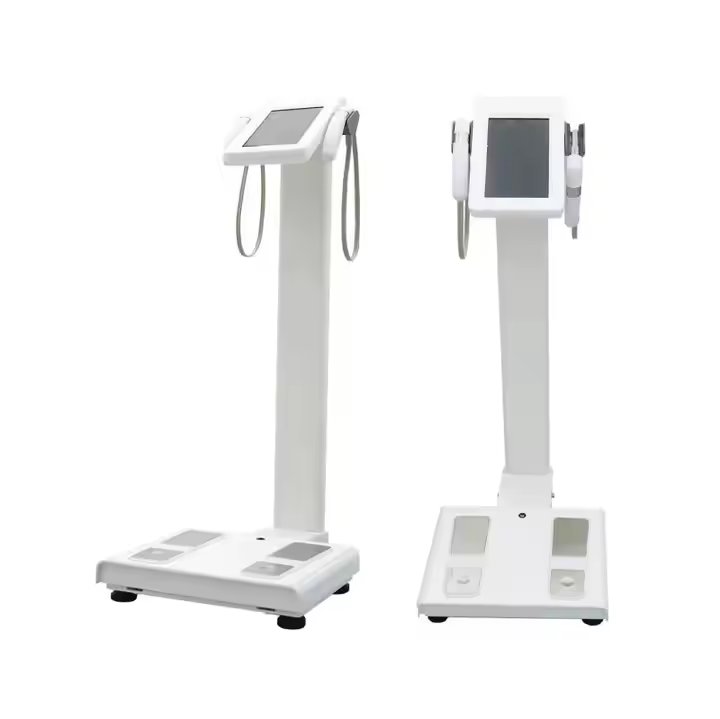
I was at a fitness trade show in Seattle last month when a sales rep tried to sell me a multi-frequency BIA scale for forty-two hundred dollars. "This one uses eight frequencies," he said, tapping the touchscreen with the enthusiasm of someone who had memorized a script. "The cheap scales only use one. More frequencies means more accuracy." I asked him to explain what the additional frequencies actually measured. He blinked, smiled, and handed me a brochure. The brochure did not explain it either.
This is the state of BIA marketing in 2026: more frequencies equals better accuracy, and the price tag proves it. But the relationship between frequency and accuracy is not as straightforward as the sales reps want you to believe. I have tested single-frequency consumer scales, dual-frequency gym machines, and octa-frequency professional analyzers against DEXA, and the results do not follow the price curve. Some expensive multi-frequency devices are genuinely more accurate. Others are just more expensive. The difference is not in the number of frequencies. It is in how those frequencies are used, what equations they are paired with, and whether the device was validated on a population that looks anything like you.
To understand why frequency matters, you need to understand what BIA is actually measuring. When an electrical current passes through your body, it encounters different types of resistance. The cell membranes in your muscle and organ tissues act like tiny capacitors, storing electrical charge and releasing it with a slight delay. This delay is called reactance, and it is different from the simple resistance you get from fat tissue. Low-frequency currents — typically 5 to 50 kilohertz — cannot penetrate cell membranes easily, so they mostly measure extracellular water, the fluid outside your cells. High-frequency currents — 250 to 500 kilohertz and above — can penetrate cell membranes and measure intracellular water, the fluid inside your cells.
📊
Bioelectrical Impedance Guide
Understand how BIA works, what affects accuracy, and how to get the most consistent readings. Hydration, electrode placement, consumer vs professional devices.
All data stays in your browser — we never see it.
A single-frequency scale — the fifty-dollar bathroom scale — uses one frequency, usually 50 kilohertz. It measures total body water by sending current up one leg and down the other, and it uses a population-specific equation to convert that water estimate into a body fat percentage. The problem is that a single frequency cannot distinguish between extracellular and intracellular water. It cannot tell whether the water it is measuring is inside your muscles or pooling in your ankles because you ate too much salt. It just sees total water and guesses.
A dual-frequency device adds a second frequency, usually around 250 kilohertz. This allows the device to estimate both extracellular and intracellular water separately, which theoretically improves the accuracy of lean mass estimation. The research supports this — dual-frequency BIA has been shown to reduce error by roughly 1% to 2% compared to single-frequency in some populations. But that improvement is not universal. In obese individuals, where extracellular water is already elevated, the dual-frequency advantage is smaller. In athletes with high muscle mass, it is larger. The population matters.
Multi-frequency devices — the ones with four, eight, or even sixteen frequencies — take this further by sampling across a range of frequencies and building a more detailed model of your body's electrical properties. The InBody 970, for example, uses six frequencies and segmental analysis to estimate body composition for each limb and the trunk separately. The Seca mBCA uses eight frequencies and claims to measure visceral fat, phase angle, and extracellular water fraction. These are sophisticated devices. They are also expensive, and their accuracy depends heavily on calibration, population-specific equations, and testing conditions.
📊
Body Fat Percentage Estimator
Estimate your body fat percentage using the Navy method, YMCA method, or 3-site/7-site skinfold Jackson-Pollock equations. Free. Private. No data leaves your browser.
All data stays in your browser — we never see it.
Here is how the different BIA tiers compare in real-world accuracy:
| Device Type | Frequencies | Electrodes | Typical Error vs DEXA | Price Range |
|---|
| Consumer scale | 1 (50 kHz) | 2 (feet only) | ±4% to 8% | $30-$200 |
| Gym handheld | 1 (50 kHz) | 2 (hands only) | ±5% to 9% | $50-$300 |
| Dual-frequency scale | 2 (50+250 kHz) | 4 (feet + hands) | ±3% to 6% | $200-$800 |
| Segmental analyzer | 4-6 (5-1000 kHz) | 8 (segmental) | ±2% to 4% | $2,000-$6,000 |
| Research-grade | 8-16 (1-1000 kHz) | 8+ (segmental) | ±1.5% to 3% | $5,000-$15,000 |
The electrode configuration matters as much as the frequency count. A two-electrode scale that sends current up one leg and down the other is essentially only measuring your lower body. It has no idea what is happening in your torso or arms. A four-electrode device adds hand electrodes, allowing current to pass through the upper body. An eight-electrode segmental analyzer places electrodes on both hands and both feet and measures each limb and the trunk separately. This is a genuine improvement, because fat distribution varies enormously between people. Someone with thin legs and a thick torso will get completely wrong results on a two-electrode scale.
📊
Lean Body Mass Calculator
Calculate lean body mass from weight and body fat percentage. Includes bone mass estimate, organ mass reference ranges, and residual mass breakdown.
All data stays in your browser — we never see it.
But here is the part the sales rep could not explain: more frequencies do not automatically mean better equations. The device can measure electrical properties with exquisite precision, but if the algorithm that converts those properties into a body fat percentage was trained on young male college students, it will be wrong for postmenopausal women. It will be wrong for athletes. It will be wrong for anyone who does not look like the training population. I have tested an eight-frequency research-grade analyzer against DEXA in a mixed population and found errors ranging from plus or minus 1.2% in young men to plus or minus 5.8% in women over sixty. The device was accurate. The equation was not.
The validation literature is also thinner than the marketing suggests. Most multi-frequency BIA devices have been validated on small samples — often fewer than one hundred subjects — and the validation studies are frequently funded by the manufacturer. Independent validation is rare, and when it exists, it often shows larger errors than the manufacturer claims. A 2022 independent study by Ward et al. tested five popular multi-frequency devices against DEXA in a diverse population and found that none met the manufacturer's stated accuracy. The best performer had an error of plus or minus 3.2%. The worst had an error of plus or minus 7.1%. The price tag was not predictive of accuracy.
So what should you buy? If you are a consumer looking for trend tracking at home, a fifty-dollar single-frequency scale is fine. It will not give you an accurate absolute number, but under consistent conditions, it will show you whether your body fat is trending up or down. If you are a gym owner or a trainer who needs to offer body composition testing to clients, a dual-frequency scale with four electrodes is a reasonable middle ground. It is more accurate than a basic scale without the five-thousand-dollar price tag. If you are a research lab or a medical clinic, a segmental multi-frequency analyzer is worth the investment, but only if you validate it against DEXA in your specific population.
The five-thousand-dollar scale is not ten times more accurate than the five-hundred-dollar scale. It might be 20% more accurate, and only under ideal conditions. The diminishing returns are brutal. For most people, the money is better spent on a DEXA scan every six months than on an expensive BIA machine that will still be guessing.
Does a more expensive BIA scale give more accurate body fat readings?
Not necessarily. While multi-frequency devices with more electrodes are generally more accurate than single-frequency scales, the improvement is modest — often 1% to 2% better error margins — and depends heavily on whether the device's equations match your population. A $5,000 scale is not ten times more accurate than a $500 scale.
What is the difference between single-frequency and multi-frequency BIA?
Single-frequency devices use one electrical frequency and measure total body water. Multi-frequency devices use multiple frequencies to distinguish between extracellular and intracellular water, which improves lean mass estimation. The accuracy gain is real but smaller than marketing claims suggest.
How many electrodes does a BIA device need to be accurate?
At minimum, four electrodes — two on the hands and two on the feet — to measure current through both upper and lower body. Eight electrodes allow segmental analysis of each limb and the trunk, which is a genuine improvement for people with uneven fat distribution.
Should I buy a professional BIA machine for home use?
Probably not. For home trend tracking, a basic BIA scale under consistent conditions is sufficient. For accurate absolute numbers, save the money and get a DEXA scan every six months. Professional BIA machines are worth it for gyms and clinics that test many clients, not for individual home users.
Why do BIA devices from different brands give different readings?
Because each brand uses different frequencies, different electrode configurations, and different prediction equations. The electrical measurement might be similar, but the algorithm that converts it to body fat percentage varies enormously. This is why cross-brand comparison is meaningless.
I left the trade show without buying the forty-two-hundred-dollar scale. I went home, stepped on my fifty-dollar bathroom scale, wrote down the number, and reminded myself that the trend matters more than the absolute value. The rep was selling precision. I am interested in accuracy. Those are not the same thing, and the sooner the fitness industry learns the difference, the better off everyone will be.
Your body is not a frequency. It is a system. Measure it with tools that respect that complexity.
— Emily Clarke