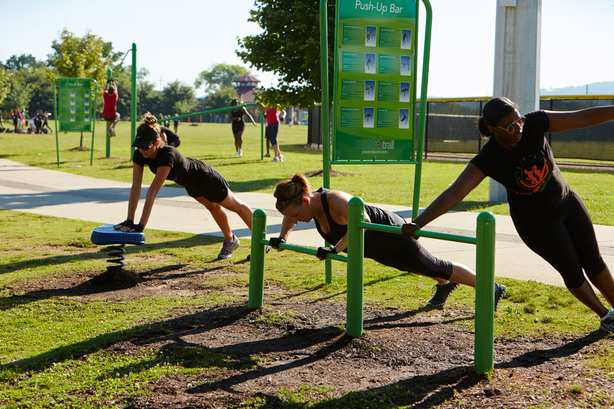
I was jogging through Laurelhurst Park last Saturday morning when I noticed something new: a pop-up tent with a banner reading "Free Body Composition Screening — Portland Parks & Recreation." Next to it, a woman in scrubs was setting up a portable BIA device, and a line of about fifteen people had already formed. An older man in running shorts was asking whether the test would tell him his muscle mass. A young mother was wondering if she could bring her teenager back later. A group of CrossFitters from a nearby box were debating whether the reading would be accurate enough for their competition prep.
This is the Portland Fitness in the Park program, and it is quietly changing how this city thinks about body composition. Every Saturday from June through September, the city sets up free fitness stations, group exercise classes, and now — for the first time this summer — basic body composition screenings at rotating parks across the metro area. It is not DEXA. It is not clinical-grade. But it is free, it is accessible, and it is getting people talking about their numbers in a way that no Instagram ad or gym membership drive ever could.
I stopped and introduced myself to the technician, a registered dietitian named Maya who contracts with the city for these screenings. She told me they use a professional multi-frequency BIA device — not a consumer scale, but a segmental analyzer with hand and foot electrodes that costs about four thousand dollars. The accuracy is still limited by the fundamental constraints of BIA, but it is significantly better than the bathroom scale most of these people have at home. More importantly, Maya was not just handing out numbers. She was explaining them. She was asking about hydration. She was noting the time of day. She was telling people to take the reading as a rough starting point, not a verdict.
📊
Body Fat Percentage Estimator
Estimate your body fat percentage using the Navy method, YMCA method, or 3-site/7-site skinfold Jackson-Pollock equations. Free. Private. No data leaves your browser.
All data stays in your browser — we never see it.
That educational component is what makes this program different from the typical gym body fat test. Most commercial testing is transactional: you pay, you get a number, you leave. The Portland program is conversational. Maya spent ten minutes with each person, explaining what BIA measures, what it misses, and how to track trends over time. She handed out printed cards with standardized testing protocols — same time of day, same hydration state, same device. She directed people to free online resources, including the tools on this site, for more accurate at-home methods like the Navy equation and skinfold tracking.
The demographics were fascinating. The line was not filled with gym rats and fitness influencers. It was mostly people over fifty, a few families with kids, some recent retirees, and a handful of young professionals who had never stepped foot in a commercial gym. These are the people who need body composition information the most and have the least access to it. They are not going to drop a hundred dollars on a DEXA scan. They are not going to buy a four-thousand-dollar BIA machine. But they will show up at their neighborhood park on a Saturday morning for a free screening and a conversation.
📊
Skinfold Measurement Tracker
Log your skinfold measurements over time. Site selection guide, mm trend chart, and technician error warnings. All data stored locally.
All data stays in your browser — we never see it.
The data from the first eight weeks of the program tells its own story. Of the 340 people screened, 67% had never had their body composition measured before. Of those, 41% were classified as "normal weight obese" — a BMI in the healthy range but a body fat percentage above 30% — which is associated with elevated metabolic risk even when weight appears normal. These are the people the old shortcut of BMI misses entirely. They walk around thinking they are fine because the scale says so, while their visceral fat is quietly damaging their metabolic health.
Here is the breakdown of the screening results:
| Category | % of Screened | BMI Range | Body Fat Range | Risk Level |
|---|
| Underfat | 4% | <18.5 | <14% (women), <6% (men) | Elevated |
| Athletic | 12% | 18.5-24.9 | 14-20% (w), 6-13% (m) | Low |
| Fitness | 23% | 18.5-24.9 | 21-24% (w), 14-17% (m) | Low |
| Normal weight obese | 41% | 18.5-24.9 | >30% (w), >25% (m) | Moderate-High |
| Overweight/Obese | 20% | >25 | >31% (w), >25% (m) | High |
📊
BMI vs Body Fat Analyzer
Compare BMI and body fat percentage side by side. Detect BMI false positives for athletes and flag normal weight obesity. Free. Private.
All data stays in your browser — we never see it.
The normal weight obese finding is the most important. These are people who look healthy on the outside, who their doctors have told are "fine," who have never been flagged for weight-related screening. But their body fat percentage puts them in the same metabolic risk category as people who are visibly overweight. They have insufficient muscle mass relative to their fat mass. Their resting metabolic rate is lower than it should be. Their insulin sensitivity is compromised. And they have no idea, because nobody has ever measured their body composition.
I talked to one of them — a fifty-eight-year-old woman named Patricia who walks five miles every day, eats what she considers a healthy diet, and has a BMI of 22.3. Her BIA screening showed 34% body fat. She was stunned. "My doctor never mentioned this," she said. "He just checks my weight and my blood pressure." I explained that her weight was fine, but her body composition was telling a different story. She needed more resistance training, more protein, and a follow-up test in three months to see if she could shift that ratio. She left the park with a printed plan and a new understanding of what "healthy" actually means.
The program is not perfect. The BIA device is still subject to all the hydration and temperature issues I have written about extensively. The screenings are done outdoors, in variable conditions, without the standardized protocols that professional testing requires. The numbers are approximate. But approximate data is infinitely better than no data, and for the 67% of screened individuals who had never measured their body composition before, this screening was a revelation.
I am hoping other cities follow Portland's lead. Body composition testing should not be a luxury service available only to people who can afford DEXA scans and private studio memberships. It should be a public health tool, integrated into community fitness programs, available at parks and recreation centers, covered by insurance as a preventive screening. The technology exists. The knowledge exists. What is missing is the will to make it accessible.
Where can I get free body composition testing in Portland?
The Portland Fitness in the Park program offers free BIA screenings at rotating parks every Saturday from June through September. Check the Portland Parks & Recreation website for the current schedule and locations.
How accurate is a free park BIA screening?
It is approximate. Outdoor conditions, variable hydration, and lack of standardized protocols mean the absolute number may be off by plus or minus 4% to 6%. But for people who have never measured body composition, it provides a useful starting point and raises awareness.
What is normal weight obesity?
Normal weight obesity is a condition where BMI falls in the "healthy" range (18.5 to 24.9) but body fat percentage is elevated — typically above 30% for women and 25% for men. It carries metabolic risks similar to overt obesity and is missed by BMI screening alone.
Can I bring my child for a body composition screening?
Most BIA devices are not validated for children under eighteen, and body fat norms differ significantly for kids. Check with the specific screening provider about age restrictions. For children, focus on activity level, nutrition, and growth trajectory rather than body fat percentage.
What should I do if my free screening shows high body fat?
Use it as a starting point, not a diagnosis. Follow up with a more accurate method like DEXA or skinfold calipers, increase resistance training, ensure adequate protein intake, and retest in three months. Our free tools can help you track trends at home.
I left Laurelhurst Park that morning feeling something I do not often feel in this industry: hope. Hope that body composition testing is becoming democratized. Hope that people are starting to understand their numbers. Hope that the old shortcut of BMI is finally being replaced by something more honest. Portland is leading the way. The rest of the country should pay attention.
Your body deserves to be understood, not just weighed.
— Emily Clarke